BDC Weekly: America Is Building AI. Private Credit Is Writing the Checks.
The AI boom is leaving the screen and entering the physical world. Private credit is helping finance the concrete, power and compute. Here is where BDC investors fit.
Updated September 14, 2026.
By The Drift Research Team
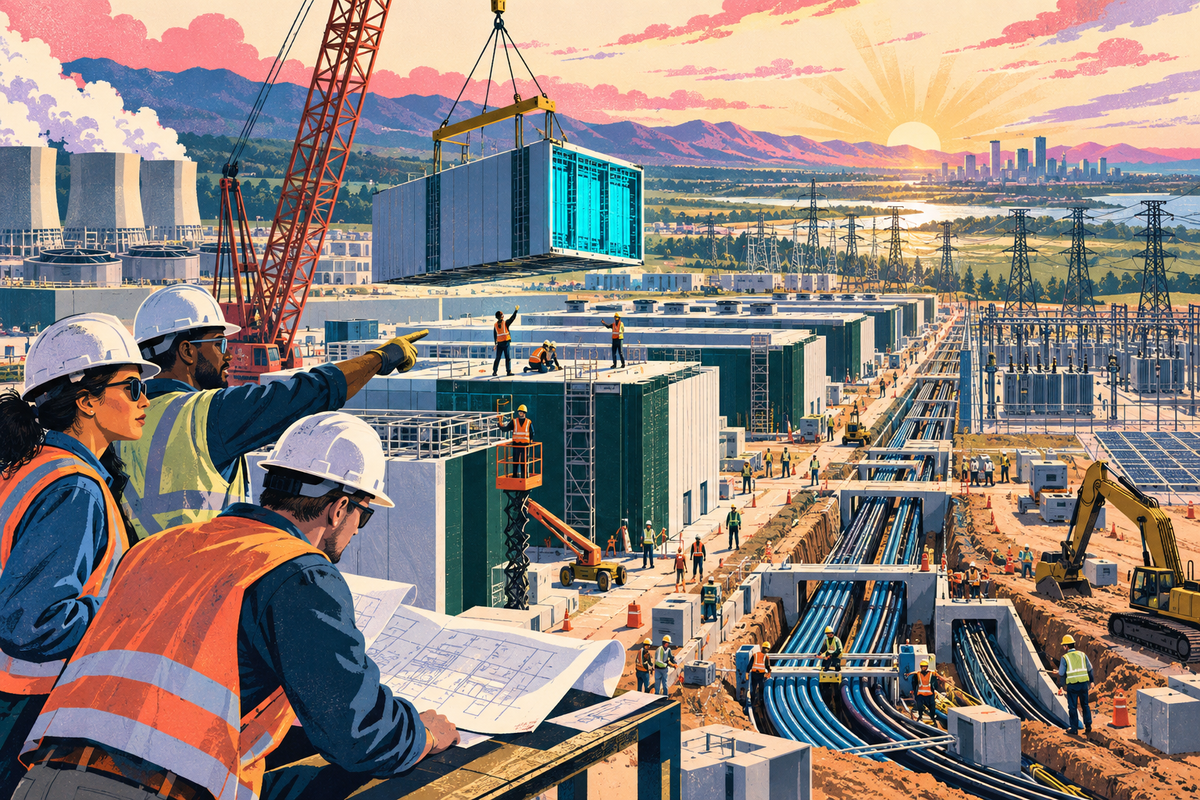
America is building something. The artificial-intelligence boom is becoming a physical construction project, and private credit is moving from the financial wings toward center stage.
The old version of the AI trade lived on a screen: chips, models, software and a handful of enormous technology stocks.
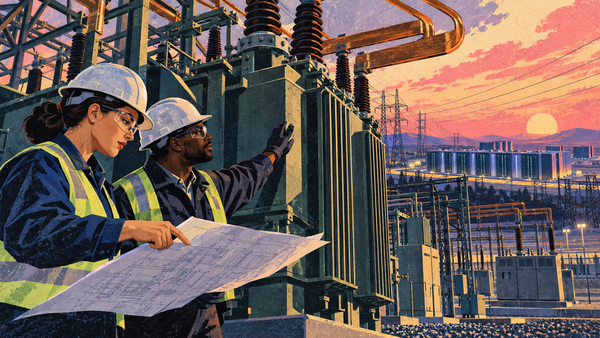
The next version needs land, substations, cooling systems, transmission lines, fiber, backup power, buildings and warehouses full of expensive compute. All of it has to be built before the revenue fully arrives. That time gap is where credit enters the story.
In August, NVIDIA announced memorandums of understanding with Apollo, BlackRock, Blackstone, Brookfield, Goldman Sachs and KKR to establish independent financing platforms intended to mobilize more than $500 billion of third-party capital for AI infrastructure over time. Goldman Sachs Research separately estimated that nearly $500 billion of AI-related debt had already been issued in 2026 across the broader ecosystem.
Those are not the same number, and neither is a suitcase of cash already sitting beside a construction site. The NVIDIA figure is a stated ambition for future financing platforms. The Goldman figure is an estimate of debt issuance already completed across public and private markets.
Together, they reveal the same machinery: artificial intelligence is becoming one of the largest credit stories in the market.
For individual investors, Business Development Companies (BDCs) are one public doorway into private lending. But the doorway is not the whole building. A BDC may finance software, power services, equipment, digital infrastructure or other businesses touched by the buildout. That does not mean every BDC owns data-center loans, or that a financing announced by its parent asset manager belongs to the public BDC.
The opportunity is real. So is the need to read the fine print.
The machine behind the boom
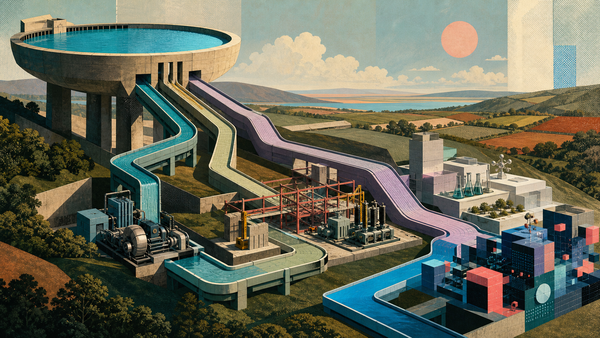
A data center is not merely real estate with better wiring. It is a stack of assets with different useful lives, risks and potential lenders.
The AI infrastructure capital stack
One buildout, five different financing jobs
The asset changes as the project matures. The lender, structure and central risk should change with it.
Goldman Sachs describes the financing life cycle in similar terms: private credit can fund land and pre-development; banks, private credit and insurance funds can support construction; and mature assets may be refinanced through term loans, private placements, ABS or CMBS.
This is why calling the entire buildout "private credit" is tempting and wrong.
Private credit is one important lane. Infrastructure equity is another. Public investment-grade bonds, high-yield bonds, bank loans, real estate finance, project finance and securitization all have jobs to do. The labels can blur because a large alternative manager may supply several kinds of capital through different funds.
The financing question is not simply, "Who wrote the check?"
It is, "Which pool of capital took which risk, against which asset, for how long, and with what claim on the cash flow?"
That is credit analysis. The AI boom is giving it a very large new construction site.
One completed transaction shows the structure
Apollo's January transaction with Valor Equity Partners and xAI offers a concrete example.
Apollo-managed funds and affiliates led a $3.5 billion capital solution supporting Valor Compute Infrastructure's $5.4 billion acquisition and lease of data-center compute equipment, including NVIDIA GB200 GPUs, to an xAI subsidiary. The arrangement used a triple-net lease structure, under which the tenant generally carries specified operating costs in addition to rent.
That is not a conventional middle-market cash-flow loan. It is asset-based finance wrapped around costly equipment, a long-term user and contractual payments.
It also was not identified as an investment by a named public BDC. "Apollo financed it" does not automatically mean a shareholder in an Apollo-affiliated BDC owns the loan. Asset managers operate many separate funds and accounts with different mandates.
That distinction should become a reflex for BDC investors:
Sponsor activity is a clue. A BDC's filed schedule of investments is evidence.
Higher rates pay lenders and test the project
The AI construction boom is arriving in a credit market that pays lenders well and charges borrowers accordingly.
The following readings all come from September 10, the latest single completed observation date shared across The Drift's production rate series:
Credit market dashboard
The base rate pays. The long end presses.
The tension: lenders are being paid, but borrowers and long-lived projects must carry the same expensive money.
This is a peculiar combination. The risk-free foundation is expensive, while corporate spreads do not signal broad panic.
For lenders, elevated base rates can produce substantial current income. For borrowers, the same coupon must be paid from operating cash. A project that looked handsome when long-term money cost less can become fragile when construction delays, power constraints or weaker utilization meet a higher refinancing rate.
That is especially important for AI infrastructure because the spending arrives first and the revenue arrives later. BlackRock calls this the financing "hump": capital expenditure is front-loaded while eventual cash flow is back-loaded.
Credit can bridge that gap. Credit cannot repeal it.
Where BDCs fit for individual investors
Congress created BDCs to channel capital toward smaller and middle-market American companies. Most BDCs make privately negotiated loans, many with floating interest rates, and trade publicly like stocks.
That structure gives individual investors something institutions have long prized: listed access to private lending economics, including contractual income, security interests, covenants and negotiated terms.
The AI buildout can reach BDC portfolios through several routes:
- Direct infrastructure and equipment finance. A BDC or affiliated credit platform may lend against digital infrastructure, power assets or equipment.
- The supply chain. Electrical contractors, cooling specialists, fiber providers, component manufacturers, maintenance firms and energy-service companies may need growth capital.
- Software and services. Portfolio companies may sell into the AI ecosystem or use AI to improve margins.
- Second-order industrial demand. Construction, logistics, security, workforce training and regional services can expand around large projects.
- Private-credit capacity. As enormous transactions consume bank and bond-market capacity, private lenders may find more opportunities elsewhere in the credit system.
This is the constructive case. BDCs can help turn public savings into private-company financing while giving retail investors a liquid security through which to study and potentially access that process.
But there is no free "AI yield" hiding inside a ticker symbol.
The investor still has to identify the actual borrower, collateral, seniority, coupon, maturity, covenant package and concentration. If the exposure cannot be found in the BDC's filings or management disclosures, it should not be assumed.
The public doorway is not the whole building
There are three mistakes investors should avoid.
First, do not confuse an asset manager with its BDC. BlackRock, Blackstone, Apollo and other large firms manage multiple vehicles. Capital supplied by one fund does not become an asset of every affiliated fund.
Second, do not confuse financing the AI ecosystem with owning the AI upside. A lender receives interest and principal if the contract performs. It usually does not capture the unlimited upside of an equity owner. That is the bargain of credit: a narrower return claim in exchange for contractual priority and downside protections.
Third, do not assume "technology exposure" is automatically an AI benefit. BlackRock's private-credit research highlights software as both a meaningful portfolio exposure and an area where AI disruption, valuation resets and refinancing needs may separate stronger borrowers from weaker ones.
AI can create loans on one side of a BDC portfolio and pressure legacy software borrowers on the other.
That is not a contradiction. It is the portfolio.
What could go wrong
The exciting part is easy to see: a once-in-a-generation buildout needs money, and lenders can provide it.
The hard part is deciding which cash flows deserve to survive for ten or twenty years.
Five risks deserve particular attention:
- Power and interconnection risk. A building without reliable electricity is an expensive shell. Grid access, generation capacity and local approvals can control the schedule.
- Tenant concentration. A facility or equipment pool may depend on one large customer. Strong contracts matter, but counterparty concentration remains concentration.
- Technology obsolescence. A warehouse can last for decades. Compute equipment may age much faster. Loan amortization and residual-value assumptions must respect that difference.
- Construction and cost risk. Delays, labor shortages, equipment bottlenecks and redesigns can consume contingency budgets before revenue begins.
- Refinancing and utilization risk. The project may need new capital before demand, pricing or occupancy develops as expected.
The industry does not need every project to fail for lenders to feel pain. It only needs financing structures that assumed perfect execution.
The weekly BDC read-through
The Drift's Supabase editorial-intelligence system completed fresh SEC, company-news, macro, Federal Reserve Economic Data (FRED) and institutional-research collections on September 14. The latest recap packet, for the week ended September 11, was marked ready for editorial review.
The company-level filings still show active BDC capital markets. Ares Capital Corporation (ARCC) and Capital Southwest Corporation (CSWC) filed final prospectus materials during the week, continuing the funding story examined in the previous BDC Weekly. The new information here is broader: BDC funding activity is occurring beside an AI buildout that may absorb capital across nearly every credit channel.
The same rate environment works on both sides of the BDC ledger. SOFR can support income on floating-rate assets. High Treasury yields can raise the cost of unsecured notes and make safer income alternatives more competitive. The deciding variables are the spread between asset income and liability cost, the borrower's ability to pay cash interest, and the lender's discipline at origination.
That is why the AI story belongs in BDC Weekly. It is not merely a technology theme. It is an origination, collateral, concentration and funding-cost theme.
The Drift view
America is not just training models. It is pouring foundations.
The buildout will require patient capital because power plants, transmission equipment, data centers and compute leases do not arrive on the same schedule. Public markets will finance part of it. Private markets will finance part of it. The most interesting structures will combine the two.
BDCs can give individual investors a public window into that private-credit economy. They may finance pieces of the AI supply chain, benefit from a larger demand for private capital, and earn income from floating-rate loans while base rates remain elevated.
But the window has glass in it. A BDC is a diversified lender with its own funding costs, fee structure, legacy exposures and credit mistakes. It is not a pure claim on the American AI buildout.
That is the grown-up version of the opportunity, and it is more interesting than the slogan.
Private credit can help build the next industrial system. The lenders that matter will be the ones willing to ask what the collateral is worth, who writes the rent check, where the electricity comes from, and whether the loan still works when the grand forecast becomes an ordinary Tuesday.
Drift Rating: structurally important, rich with lending opportunity, and demanding of unusually specific underwriting.
What we are watching next
- Whether the NVIDIA partnerships progress from memorandums of understanding to funded vehicles and disclosed transactions.
- Which financing pools provide equity, private credit, equipment finance and project debt, and whether any exposure appears in public BDC filings.
- Whether AI-related credit supply widens spreads or creates better terms for lenders as issuance grows.
- Whether data-center leases, utilization and contracted power support the cash flows assumed at origination.
- Whether BDC software portfolios show growing dispersion between AI beneficiaries and disrupted borrowers.
- Whether SOFR remains high enough to support asset income without pushing more borrowers toward amendments, Payment-in-Kind (PIK) interest or non-accrual status.
Investor quick answers
Is private credit financing AI data centers?
Yes, but it is one part of a larger capital stack. Private credit can finance development, construction, equipment or stabilized assets alongside infrastructure equity, bank loans, insurance capital, public bonds and securitizations.
Can individual investors access private credit through BDCs?
BDCs are publicly traded companies that primarily invest in private or thinly traded businesses, often through secured loans. They can provide listed access to private lending, but their portfolios, leverage, fees and market prices vary.
Which BDCs invest in AI data centers?
There is no reliable answer based on a sponsor name or marketing theme alone. Investors should inspect each BDC's latest SEC-filed schedule of investments and management commentary for named borrowers, industries, collateral and position size. Sponsor-level AI financing does not prove that the affiliated BDC owns the exposure.
Why are higher rates good and bad for BDCs?
Many BDC assets have floating coupons, so higher SOFR can increase portfolio income. Higher rates also increase borrower interest expense, BDC funding costs and competition from Treasury securities. The net effect depends on asset-liability structure and credit performance.
What is the biggest credit risk in AI infrastructure?
There is no single risk. Power availability, construction execution, tenant concentration, equipment obsolescence, utilization and refinancing can each break the expected cash-flow chain. Good underwriting matches loan maturity and amortization to the life of the underlying asset and contract.
Acronyms and terms
- ABS: Asset-Backed Securities, bonds supported by cash flows from a pool of financial or physical assets.
- ARCC: Ares Capital Corporation.
- BDC: Business Development Company, a regulated investment company designed to provide capital to eligible businesses.
- CMBS: Commercial Mortgage-Backed Securities, bonds supported by commercial real estate loans.
- CSWC: Capital Southwest Corporation.
- FRED: Federal Reserve Economic Data, the economic database maintained by the Federal Reserve Bank of St. Louis.
- GPU: Graphics Processing Unit, specialized computing hardware widely used to train and operate AI models.
- OAS: Option-Adjusted Spread, the additional yield over a benchmark after accounting for embedded options.
- PIK: Payment-in-Kind interest, interest added to principal rather than paid in cash.
- SOFR: Secured Overnight Financing Rate, a benchmark based on overnight Treasury-repurchase transactions.
Read next
- How AI Infrastructure Gets Financed
- Asset-Backed Finance and AI Infrastructure
- Who Finances AI Data Centers?
- What Is a Business Development Company?
- Floating-Rate Loans Explained
- The Private Credit Refinancing Wall
- The Drift BDC Credit & Income Monitor
Source notes
- NVIDIA and Apollo, NVIDIA Partners with Apollo, BlackRock, Blackstone, Brookfield, Goldman Sachs and KKR, August 10, 2026. The release describes memorandums of understanding for independent platforms intended to mobilize more than $500 billion over time; it does not say that amount had already been committed or invested.
- Goldman Sachs, How AI Debt Is Reshaping Credit Markets, August 5, 2026. The nearly $500 billion of 2026 AI-related debt and $300 billion estimate for 2027 project-finance and data-center transactions are Goldman Sachs Research estimates.
- Goldman Sachs, Private Markets Are Expected to Have a Growing Role in Data Center Financing, June 12, 2026.
- Goldman Sachs, Powering the AI Era, financing-life-cycle report.
- Apollo, Apollo Backs $5.4 Billion Valor and xAI Data Center Compute Infrastructure Transaction with $3.5 Billion Capital Solution, January 7, 2026.
- BlackRock, Navigating a Maturing Private Credit Market, August 13, 2026.
- Federal Reserve Board, H.15 Selected Interest Rates, release dated September 11, 2026, reporting September 10 Treasury observations.
- Federal Reserve Bank of New York via FRED, Secured Overnight Financing Rate.
- ICE Data Indices via FRED, U.S. High Yield Option-Adjusted Spread and BBB U.S. Corporate Option-Adjusted Spread.
- U.S. Securities and Exchange Commission filings for ARCC and CSWC, filed September 10 and September 11, 2026.
- The Drift production editorial-intelligence database, BDC Weekly recap packet 117 for the week ended September 11, 2026. Fresh SEC, news, macro, FRED and institutional collectors also completed successfully on September 14, 2026.
Disclosure
The Drift is published by Drift Research LLC for informational and educational purposes only. Nothing published by The Drift constitutes personalized investment advice, financial advice, tax advice, accounting advice, legal advice, or a recommendation to buy, sell, or hold any security. The Drift is not a registered investment adviser, broker-dealer, financial planner, or fiduciary. Data and calculations are derived from sources believed reliable and from methods described in the applicable source and calculation notes, but they may contain errors, estimates, rounding differences, or information that has become outdated. Readers should review the original sources and make their own assessment. All investments involve risk, including possible loss of principal. Past performance and hypothetical results do not guarantee future results. Consult qualified professionals before acting.